For accountants
The same books your client runs on. On your own login.
If a client of yours is on NuAi or thinking about it, or we have invited you to look it over, this page is for you: what it means for a practice, what the database enforces, what it does not do yet, and what your desk gives you.
Your invitation e-mail sets the password. The desk works on a phone too.
For your practice
What this means for a practice.
A system like this, with Ai where it helps (reading a slip, say), does the capture a practice now does for its clients: keying in the sales, matching the bank, chasing the slips. That part of the work is changing, here and everywhere, and NuAi is one of the things changing it.
What does not change is the part the client, the bank and SARS rely on an accountant for: the judgement, the review, the tax work and the signature on the statements. The system does the capture; the accountant reads, reviews, has the business put right what is wrong, and signs. We think this can be good news for a practice. Tell us whether you agree.
Less work per client
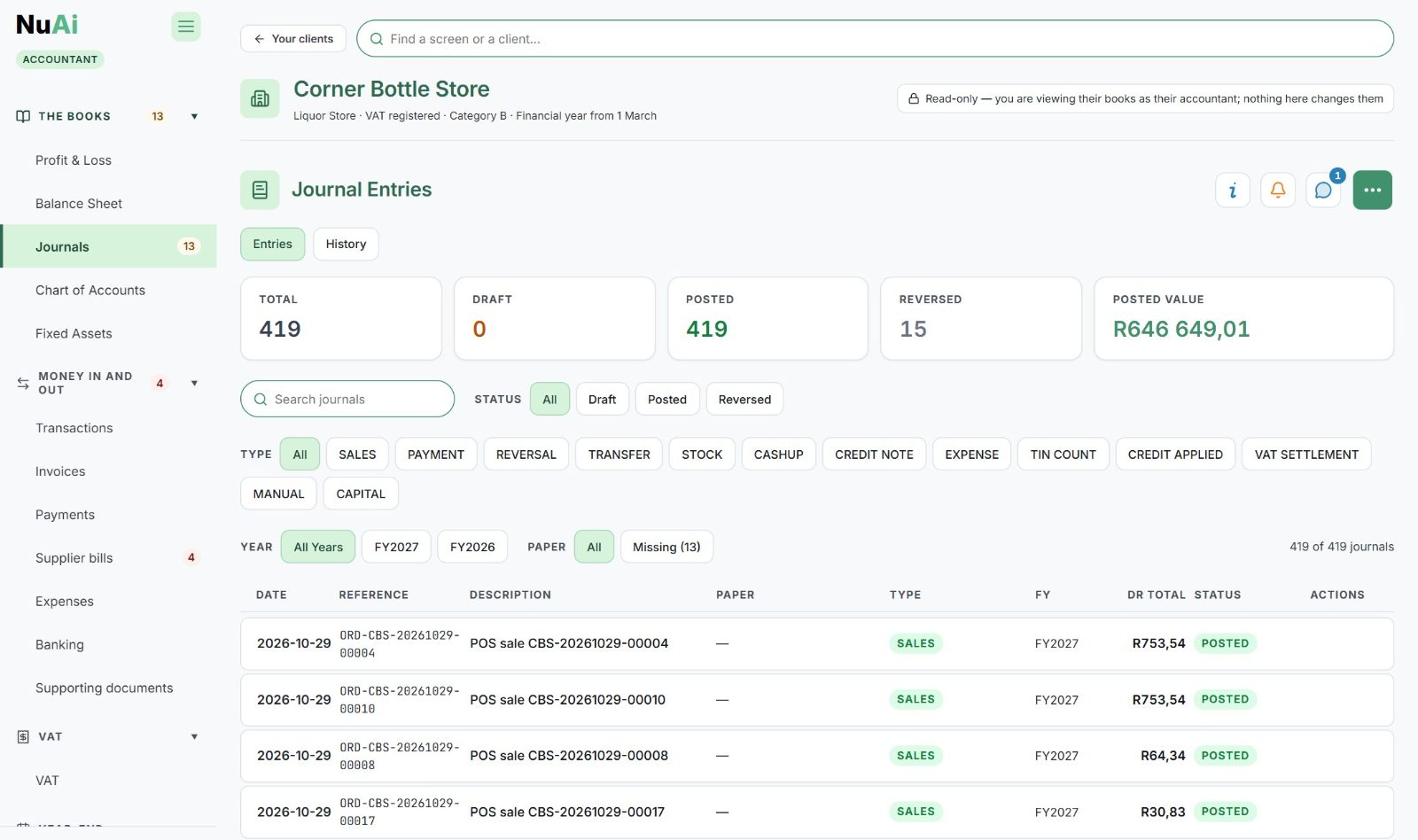
One system, one set of books: no second system to reconcile against. The books are already kept when you open them, the document behind an entry a click away, and a list of what still has no paper. Nobody chases a shoebox.
More clients in the same hours
One login opens every client who has invited you, on one screen, wherever you are.
Your name on the work
You mark a VAT period as reviewed and sign off a year's statements under your own login. Once the year is closed, the numbers you signed off stay the numbers: it reopens only with a reason that stays on the record. What that signature should say is a question we need your answer to.
New clients
Many small businesses go without an accountant because the capture uses up the budget before the review. With the capture done, they need only the review and the sign-off: a smaller job they can afford.
The road
From the counter to your desk.
- A sale, an invoice or a slip
Rung up, raised or photographed: each writes its own journal entry when it happens.
- Balanced, or refused
An entry whose debits and credits differ never reaches the books.
- The VAT201 and the trial balance
Worked out from those entries, in SARS's boxes; both download as spreadsheets.
- Your desk, read-only
Every client who invites you, on your own login. You look; you never post.
- Reviewed and signed
A VAT period marked reviewed and a year's statements signed, in your name.
The rules
Books that hold their shape.
Double-entry, and the rules an accountant relies on, with what keeps each one. The first three are enforced in the database itself, where no screen can skip them.
| When this happens | The books | Kept by |
|---|---|---|
| Debits and credits that don't agree | Refused | The database itself |
| An entry into a closed year | Refused. The year reopens only with a reason | The database |
| A sale is voided | Stays on the books, marked, with who and when | The database |
| The year is closed | The result moves to retained earnings, the year is archived as issued, and every entry in it locks | Year-End Close |
| A change to an expense, a journal or the chart | On the audit trail: who, when, before and after, and the reason where one was asked | History, the audit trail |
| The document behind an entry | Kept, never deleted; the books list what has no paper yet | Supporting documents |
| The bank's statement | Matched line by line, with any difference shown | Banking |
The statements (income statement, balance sheet, changes in equity, cash flow and the notes) are built from that ledger with last year beside this year, and their first page says what they are and what they are not.
Live, and South African
Kept as the business trades. In rand, in SARS's boxes.
No overnight batch between the till and the books: a sale at the till is a journal entry the moment it is rung up. A job invoice posts when it is raised; a supplier's slip posts once, when it is photographed and checked; a clock-in by QR becomes the timesheet the pay run is worked out from. What the owner sees, what the till shows and what you read on your desk are the same rows at the same moment.
- VAT at the rate SARS sets, line by line: standard, zero-rated or exempt, on a tax invoice or a receipt for every sale (a receipt where the business is not VAT-registered)
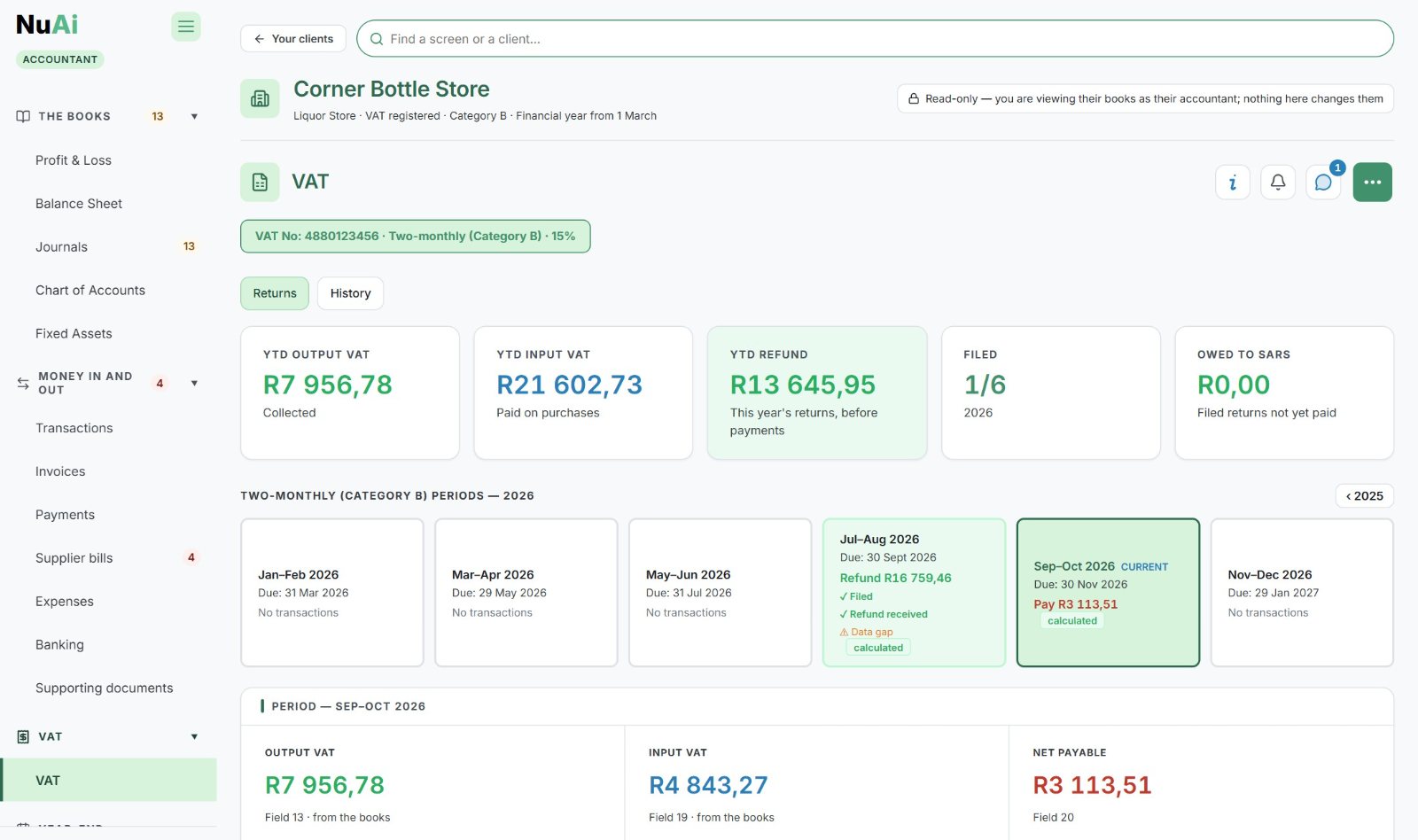
- The VAT201 in SARS's box numbers, downloaded as a spreadsheet; once filed, the return stays as filed, a payment to SARS or a refund from SARS recorded on it, never as an expense; a late entry goes on the next return
- The business's own financial year, not the calendar's: March to February, or any other
- Invoices, credit notes, statements of account and monthly invoices; once EFT or PayFast is on, every unpaid customer invoice with its own pay page, its QR code on the paper and the bank details for EFT
- Pay-run drafts worked out on NuAi's reading of the Basic Conditions of Employment Act and SARS's method (payslips are not issued until an accountant has reviewed it); the statutory figures are held as data, checked by a named person each tax year
- Rand, with the cash rounding the till actually does
- Every sign-in opens the current version: a correction made once is a correction for every business on it
Your desk
Read-only books on every client that invites you.
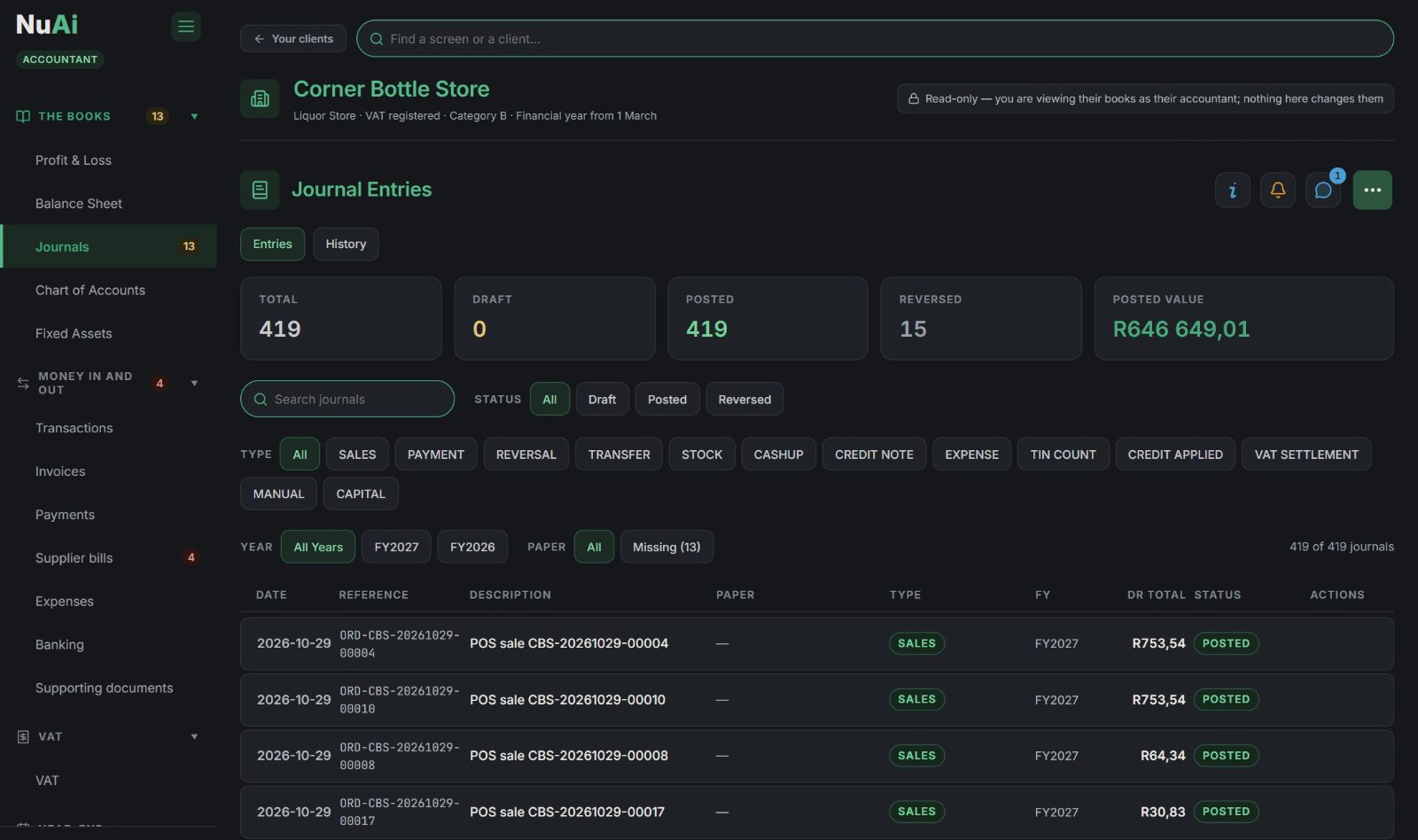
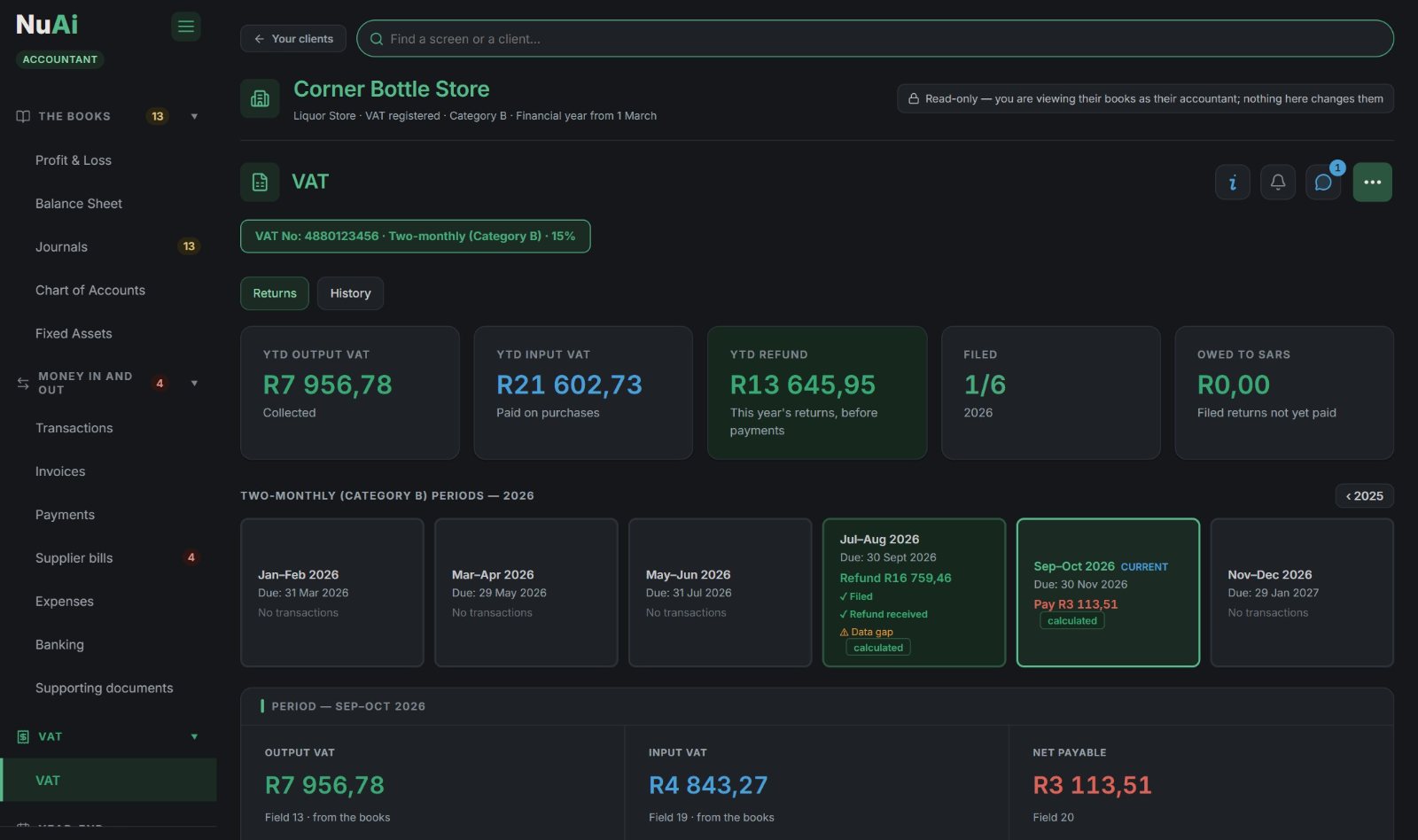
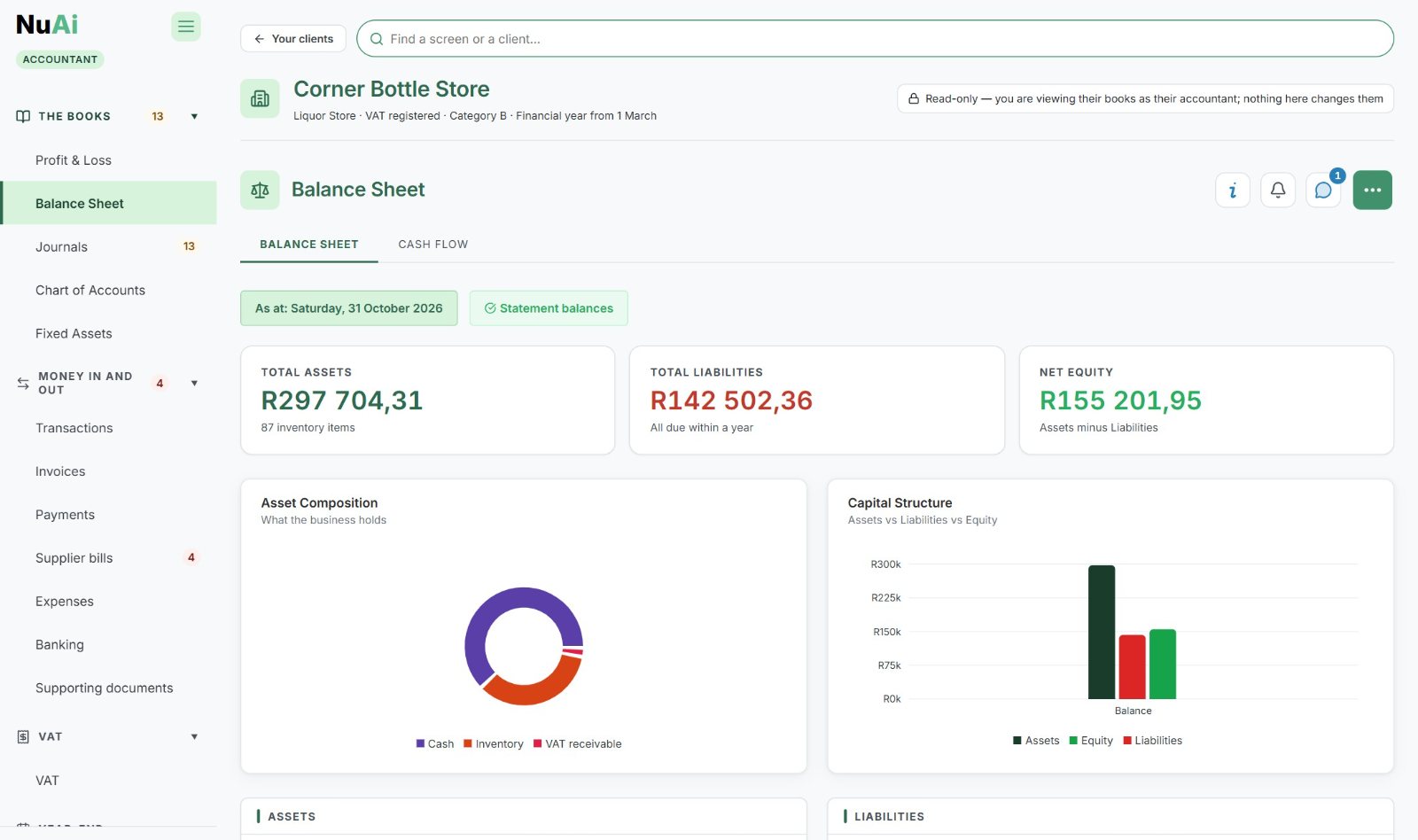
Your login opens your desk: the businesses that gave you access, each with its books (Profit & Loss, Balance Sheet, Journals, the Chart of Accounts, Transactions, Invoices, Expenses, Banking, VAT, Year-End, the IFRS Statements, the Notes and the supporting documents), exactly as the owner sees them. You cannot post, change or delete anything.
- What is missing, flagged for you: every entry with no slip or tax invoice behind it is listed. Tick the ones you need and send them back in one request; it lands live in the business's messages for the owner or an admin to answer, with e-mail reminders, and each line is marked the moment its paper arrives
- Open the document behind each entry; each open is logged, and the business sees what you opened
- Download the trial balance with every journal line and the VAT201; every copy you take is logged where the business can see it
- Mark a VAT period reviewed, against your name
- Sign a year's statements with your own login; withdrawable, on the record
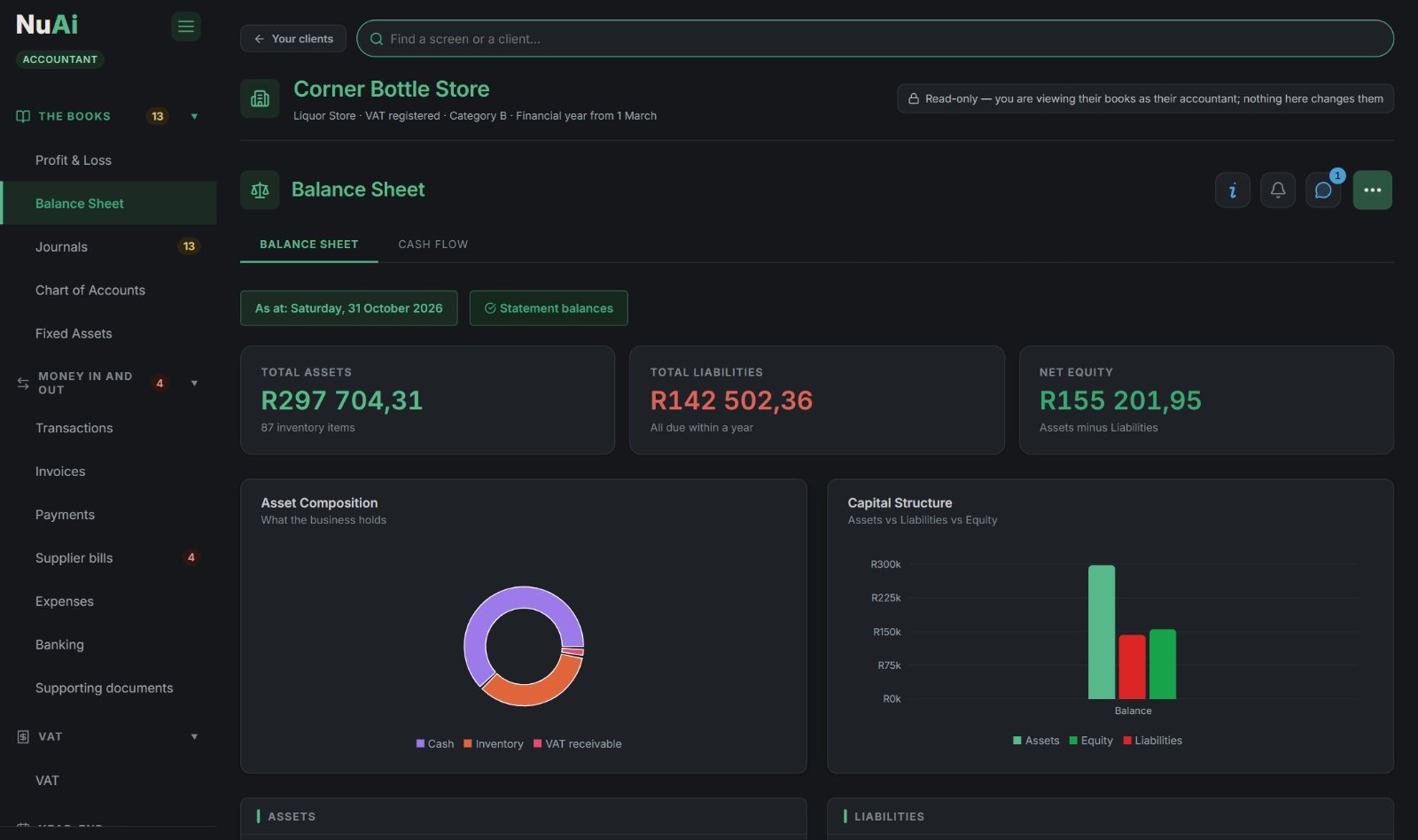
- A day mode and a night mode, and it works on a phone
If we have invited you to review NuAi itself, your login also carries our review register: every question NuAi's payroll and books raise, with what the law or SARS says, what NuAi does today and the answer we work to. You answer each one Confirmed, Corrected or Deferred, and the answer is kept against your name.
Said plainly
What it does not do yet.
NuAi is in beta, and this is what that means.
- No live bank feeds: the bank's statement comes in as the bank's own file and is matched to the books line by line
- Payroll produces drafts, not payslips, until an accountant has reviewed the method
- No card machine linked to the till yet: card sales are taken on the business's own machine and recorded
- Adjusting entries: the desk is read-only, so you cannot post a year-end adjustment yet; how you would propose one is a question we are asking you
- No client business runs on it yet
The numbers
As measured on 31 October 2026.
Read from the running system on that day, not estimates. The figures move every day; the date does not.
- 5 965commitsabout 490 000 lines of app code
- 687rules learned from mistakes foundmost with an automatic check
- 114automatic checks before every release
- 246tables in the database713 functions · 47 server functions246 of 246 walled off by business
- 10industry profiles8 built out · 16 test and demo businesses · no client business yet8 of 10 built out
- 13 284journal entries in our test businessesevery one balanced13 284 of 13 284 balanced
How it is built: NuAi is built by its founder under a written method of its own. Every mistake found becomes a written rule, and wherever a machine can check it, an automatic check that runs before anything is released.
For the reader
Three people read this page.
An accountant
A client's books kept by the system from the first sale, readable on your own login, with a review register that keeps your answers against your name, and a system that treats your correction as a rule to keep.
An insurer of a trades business
A job cannot start until its safety check is signed by the crew member on the job, and the database, not the foreman, enforces that. The site log carries photos and times. The job carries its quote, its crew, its hours, its materials, its invoice and its payment. When something goes wrong on site, the record of what was done, by whom and when, already exists.
A partner
One system a small to medium business can run its whole operation on, with books an accountant can sign, hosted and current for every business at once. We are looking for the partners who put it in front of the businesses they already serve.
Your client invites you. You sign in.
A business invites its accountant from Settings › Your Accountant with your e-mail address. One e-mail sets your password, and your login opens your desk.
Questions about the method go to Gerhardt Fivaz, the founder: gerhardt@nuai.co.za